Lay ministry
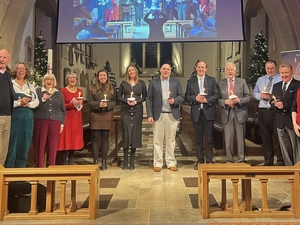
Those within our churches are either ordained clergy or lay people. And lay people can offer ministry to their congregations and local communities in a variety of ways, which we value and celebrate. In our diocese, there are three different types of lay ministry:
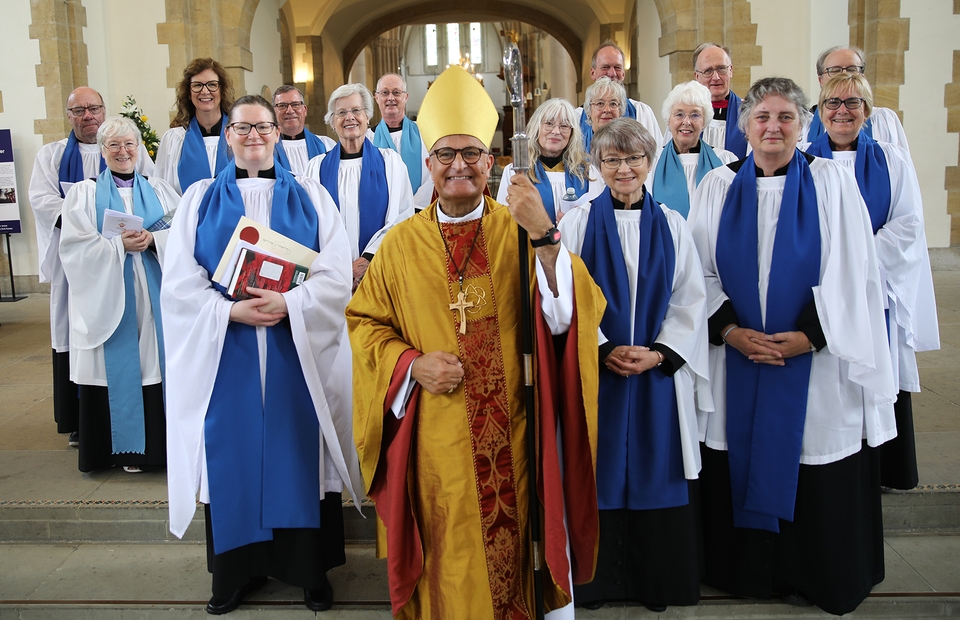
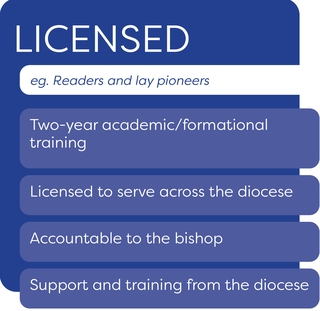
- Licensed Lay Ministers: these are people who have received theological training and formation, often for two years. They then receive a licence from the bishop and are able to preach, lead services and offer ministry across our diocese. One type of Licensed Lay Minister is a Reader. Another is a lay pioneer. Discover more about licensed lay ministry here.
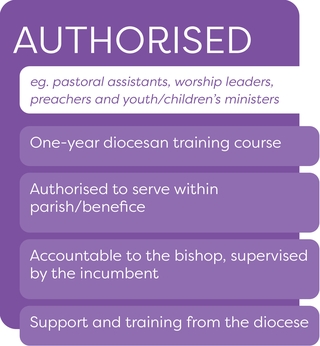
- Authorised Lay Ministers: this is a new type of lay minister, who will be introduced to our diocese in 2027. They will have received one year of theological training and formation, as well as some training in a specialism, such as leading sung worship, preaching, church-planting or work with children and young people. A new training programme for authorised lay ministry will begin in September 2026. More details below.
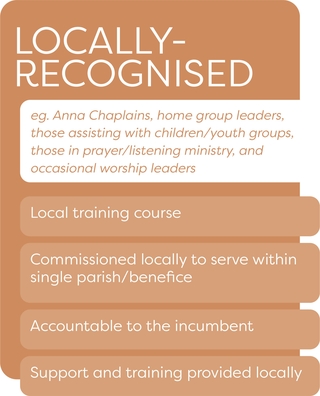
- Parish-Based Lay Ministers: these are those who have been selected and trained to offer ministry within their own parishes. They will have received some training within their parish in areas such as pastoral support, assisting with work with children and young people, leading a Bible study group, working as an Anna Chaplain with the elderly and so on.
This diagram seeks to explain the differences between the three different styles of lay ministry:

Authorised Lay Ministry
Because this is a new type of lay ministry for our diocese, it might be helpful to provide some additional information about what this entails.
Authorised Lay Ministers (ALMs) are lay people active in church life, who have been identified by their parish as having a particular gifting, vocation or calling to lay ministry. They may be called to work collaboratively alongside their incumbent and wider ministry teams with a distinct focus on growing, nurturing and serving the wider parish community.
ALMs are nominated by their incumbent and PCC for training. This initial discernment, done within parish, continues for the duration of their training on the year-long ALM programme. A completion interview, final reflective assignment, renewed support of their incumbent, PCC and the support of diocesan/ALM programme staff completing their pre-commissioning discernment.
Once this is completed, and subject to recommendation for completion, they are then commissioned by (or on behalf of) the bishop to carry out a mutually agreed ministry role within their local parish/deanery or chaplaincy context. An ALM’s authorisation lasts for three years - after which time it can be reviewed, updated and renewed, subject to the completion of a ministry review, up-to-date safeguarding training, and a current DBS.
How are ALMs different from Readers or other Licensed Lay Ministers?
The office of Reader is a lay ministry in the Church of England that is nationally accredited, episcopally licensed and governed by Canon Law. Readers have undergone more substantial theological training and are licensed by the bishop to preach, teach and conduct funerals as key elements of their ministry. In this sense, Readers are more deployable and can work across parish boundaries with a higher degree of autonomy.
Authorised Lay Ministers are different in that they are authorised and commissioned by (or on behalf of) the bishop for an agreed collaborative ministry role within a specific parish context (which is why their year-long course includes specific 'specialisms' or 'electives'). An ALM’s training is shorter, has less theological depth and is generally more practical in its focus. In recognition of this, ALMs cannot work across parish boundaries without explicit permission and must have a higher level of supervision and support.
ALMs that choose the preaching elective should preach up to eight times per year. All ALMs must also apply to be re-authorised every three years. However, there is always the possibility that ALM training could lead on into licenced or ordained ministry if individuals are called to this, and complete the required discernment and selection process. For further information, contact Matt Grove (details below).
Lay Ministry Discipleship Officer
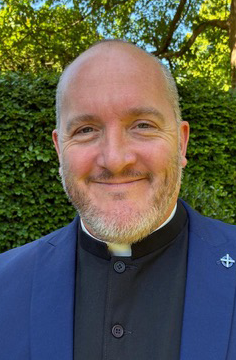
The Rev Matt Grove
Responsible for the training, development, and ministry of lay ministers across our diocese, including pioneers, children’s and youth workers, and strategic lead for growing and developing all licensed and other lay ministry pathways.
T:
E: email