Diocesan Synod, March 2026
PRESIDENTIAL ADDRESS
Bishop Jonathan spoke during the Diocesan Synod Eucharist, taking as his text the story of the Prodigal Son. He challenged synod members to decide: where is your hope anchored? And he contrasted the younger brother, who sinned but repented, with the older brother, whose attitude was that he had worked for years with little appreciation. In the story the father actually runs towards both brothers at different points. And we can learn from each brother in turn.
He encouraged synod members to anchor themselves in the God who bears our sins so that we can come home to his love. You can download and listen to the bishop’s address here.
DIOCESAN SYNOD MOTION ON FUNDING
A motion agreed by our Diocesan Synod in November 2025 regarding the national CofE’s budget for 2026-28 had led to a response by Carl Hughes. You can read both our motion and his response here.
STANDING ORDERS
Diocesan Synod members approved a new set of Standing Orders, which you can read here.
GENERAL SYNOD
Pip Collins-White, who is one of the young people co-opted onto General Synod (and the son of the Ven Bob White, Archdeacon of Portsdown) spoke about the February sessions. The synod discussed issues such as safeguarding, social care, poverty, sustainable flowers, and working-class vocations. Pip also contributed to the General Synod debate about Living in Love and Faith (LLF). And he was pleased that synod members voted against proposals to increase fees for burials by £1,000.
As he had previously worked in the House of Commons, he was interested to see the similarities and the differences between the two institutions. He also mentioned the kind of barriers that prevent young people standing for election to General Synod.
SAFEGUARDING
Head of Safeguarding Emily Hassan updated synod members about the change in safeguarding structures across the Church. Since General Synod voted in favour a move towards greater independence, Dame Christine Ryan had been appointed as the executive chair of the safeguarding structures programme. Phase 1 of the change will involve the creation of a new independent safeguarding authority, which will allow independent scrutiny and will manage the audit programme. But the local delivery of safeguarding will remain in dioceses.
Emily also reported back on the progress in implementing the recommendations of our diocese’s INEQE safeguarding audit. Various sub-groups are now looking at how to implement them.
STRATEGIC BID TO THE NATIONAL CHURCH
Our Director of Ministry and Discipleship, the Rev Andrew Hargreaves, introduced a draft version of the bid that our diocese hopes to make to the Strategic Mission and Ministry Investment (SMMI) Board later this year. The bid will once again be based on our diocese’s vision and strategy, which aims for our diocese to be “a rejuvenating community of Jesus-centred, Kingdom-seeking disciples”. It will again involve elements relating to Revive, Revitalise and Renew.
Andrew outlined the history of previous bids and the outline of the bid for this year. You can see his full presentation here and read his paper here. He talked about the history of previous bids and updated synod members on what was happening in each deanery as a result. You can see that outlined in the diagram below:
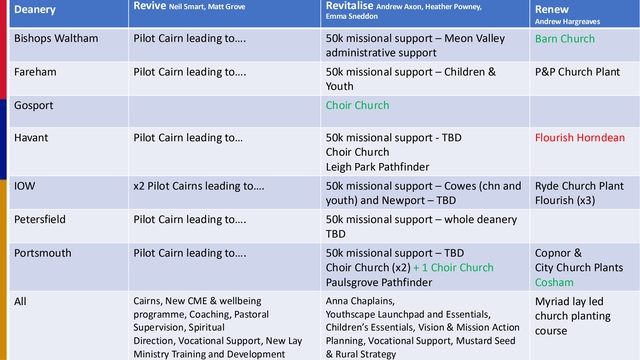
The current tranche of strategic funding involves £5.3m from the national Church, to be spent over five years, from 2025 - with matched funding from the diocese in the order of £3m. The 2026 bid for strategic funding is intended to cover the five years from 2027-31, with a £5m maximum limit. The outline of our bid includes £3.75m on larger projects, £0.75m on smaller projects (a “warchest” that can be spent on parish projects that might only need a small injection of funds), and £0.5m on the diocesan team to support this.
Among the ideas being considered are:
REVIVE:
- Further support for Cairns
- A 10-year People Plan
- A pipeline of people to work with children and young people.
REVITALISE:
- Developing the Isle of Wight Flourish projects
- Growing Choir Church
- A new Pathfinder project in a Catholic tradition
- Further smaller projects, including: School Pastors, children and youth workers, Anna Chaplaincy support, Myriad parish plants
RENEW:
- Barn Church: more support
- Berewood estate: half a stipend
- Boorley Green: church plant
- Cosham: church plant
- Cowes
- Haven Church, Gosport: youth engagement
- Portsmouth city
- Welborne: church plant
TEAM:
- Leads for Revive, Revitalise and Renew (currently vacant)
- Strategic programme team
Bishop Jonathan answered a question about the idea suggested last year for a ‘Dolling Centre’ as a focus for reconciliation and spirituality in the heart of Portsmouth. This was, he said, on hold because of the disappointing settlement we’ve received from the national Church. Others asked about ecumenical relationships, and about our certainty of receiving the strategic funding. And synod members praised the involvement of deaneries in creating this strategic bid.
Andrew Hargreaves explained that newer churches were given a period of grace with regard to parish share, but there was a 10-year plan for payments to increase, so that Harbour Church (for instance) now pays £85k each year, with £5k added each year. He explained the timetable for this bid – it would go to Diocesan Synod in June, a draft bid would be submitted in September and the final bid in October. Synod members agreed to the ongoing development of the bid.
EDUCATION UPDATE
Director of education Jeff Williams gave an update on the work of our education team, which is now part of a separate Charitable Incorporated Organisation (CIO) serving church schools in Portsmouth and Winchester dioceses. In total, 39,000 children are served across 155 church schools in both dioceses, the vast majority of whom don’t go to church. His paper is here.
Among last year’s highlights was the campaign to highlight the flawed process carried out by the Isle of Wight Council as it attempted to close schools, three of which were CofE schools. It was accepted that schools may have to close because falling numbers means funding has to be dispersed too widely. But the process was a fiasco, and the diocese ultimately had to ask the Office of the Schools Adjudicator to intervene to confirm that the process was flawed and offer a reprieve to the one CofE school that was still threatened with closure.
Jeff also talked about the education team’s involvement in the national CofE’s Growing Faith initiative, which includes a project – Chatting Faith – to encourage parents and children to discuss issues of faith as they read school storybooks together at home.
LAY MINISTRY
Our Lay Ministry Discipleship officer Matt Grove told synod members about a new way in which lay ministry might be structured in this diocese. His presentation is here, and a diagram that aims to explain this is below:
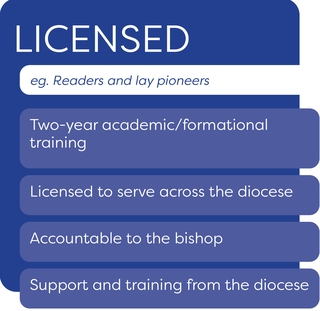
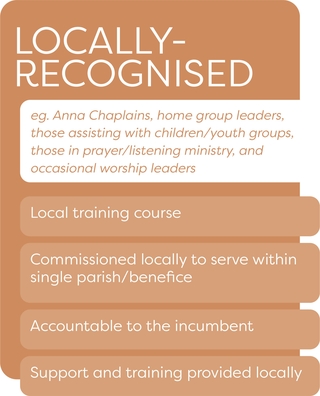
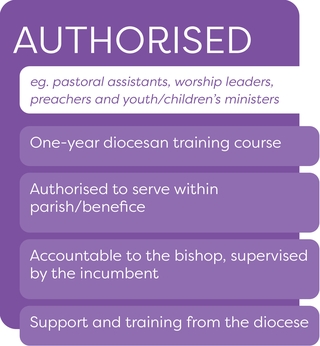
Matt explained that in September 2026, we will be launching a programme to help to train a new group of Authorised Lay Ministers, who will be discerned by their local priest and endorsed by their PCC. This group will be offered a model that includes an element of formation, over a period of one year. It will include 10 in-person days which will look at Biblical foundations for ministry, as well as thinking practically about mission and ministry. In January 2027, each of them will be asked to select an ”elective” in a specialist area, such a preaching, sung worship, pastoral care, church-planting etc.
One of the ways in which this training will happen is via an online training portal, which allows those being trained to work through text, image and video material online – to complement the in-person sessions. This portal can ultimately be used to train others, including churchwardens or other lay officers. More details are on portsmouth.anglican.org/layministry
NET ZERO CARBON
Net zero carbon officer Matt Lockwood made this presentation to synod members about our progress in this area. A commitment by our General Synod for the CofE to aim for net zero carbon emissions by 2030 had resulted in officers such as Matt being appointed with national funding.
Among recent progress was a net zero conference held in January 2026 in Guildford, for parishes across Guildford, Winchester, Chichester and Portsmouth dioceses. It attracted 150 people, including three bishops, and a stand-out part of the say was a challenge from young people from Haslemere. The day included agreement to a “Guildford declaration” which called on the Church Commissioners to find more money in the next triennium to fund the efforts to reach net zero.
He said there would be a net zero conference in 2027 – and maybe two conferences, one for Portsmouth, Guildford, Winchester and Salisbury dioceses; and one for Chichester, Canterbury and Rochester dioceses.
And he reported on progress with the collection of data via the CofE’s Energy Footprint Tool (EFT). This helps to determine the carbon footprint of each parish, based on their energy usage, which then may help with eligibility towards grants for net zero projects. In 2024 and 2025, 100% of parishes across our diocese have submitted their data via the EFT, and parishes are now invited to do so in 2026 via the Parish Returns System, with a deadline of June 30.
In response to a query about a Winchester parish that supposedly had to remove a new boiler that wasn’t net zero compliant, our registrar Sue de Candole, explained that the media reports about that parish weren’t actually accurate and the situation was more complex. And the Rev Sue Jones spoke about the installation of a new carbon-friendly heating system being installed in St Peter’s High Cross, Froxfield, with the aid of a £25k top up grant from the national church.
NATIONAL CHURCH SUPPORT
Technical problems meant that a video about national CofE support could not be shared in the meeting, but it is available here:
LOW-INCOME PARISH FUNDING
Synod members were invited to consider various aspects of Low Income Communities Funding (LInC funding), and urban ministry. LInC funding is allocated by the national Church to the lowest-income communities, to support and develop mission in our most deprived communities. The 28 dioceses that receive this funding then decide how best to support mission in communities with the lowest incomes.
(a) ANNUAL LInC REPORT
Diocesan Secretary Philip Poulter presented the annual LINC report, which you can see here. In some dioceses, LInC funding is used to support stipends, but in our diocese this funding is increasingly used to support practical projects in parishes, including funding for admin support for vicars.
(b) LInC COMMITMENT
Canon Nick Ralph, who leads on social justice in our diocese, talked about the Indices of Multiple Deprivation, which are a measure of relative wealth that has been used by the government and others since 2000. It is based on more than 33,000 neighbourhood areas, and uses data such as income, employment, access to health services, crime rates etc to provide a ranking of all 33,000 areas. The latest update to the data was in 2025, and indicates that some areas of inner-city Portsmouth, Havant and Gosport are among the most deprived in the country.
He explained that the government has introduced an initiative called Pride in Place funding, which involves up to £5bn being allocated to local people and partnerships for them to spend over the next 10 years. Each area could receive up to £20m, and Paulsgrove, Fratton, Rowner, Leigh Park and Wecock are the kind of areas that may receive this funding. In each place, the funds will be allocated by a neighbourhood board, created by local people, which includes a specific role for people of faith alongside other community leaders. His full presentation is here.
(c) LInC DISCUSSION
Synod members then heard stories from three different parts of our diocese that serve low-income communities:
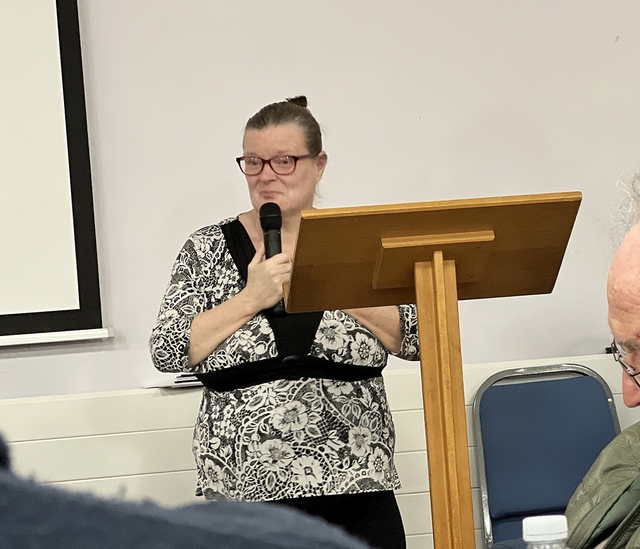
The Rev Hugo Deadman, priest-in-charge of Paulsgrove, introduced Michelle, who had launched a Bathroom Bank within St Michael’s Church. This aimed to help local people suffering from hygiene poverty by providing shampoos, shower gels, sanitary towels etc, as needed. It aimed to preserve their dignity and remove any stigma, and it had also changed many people’s perceptions of their local church.
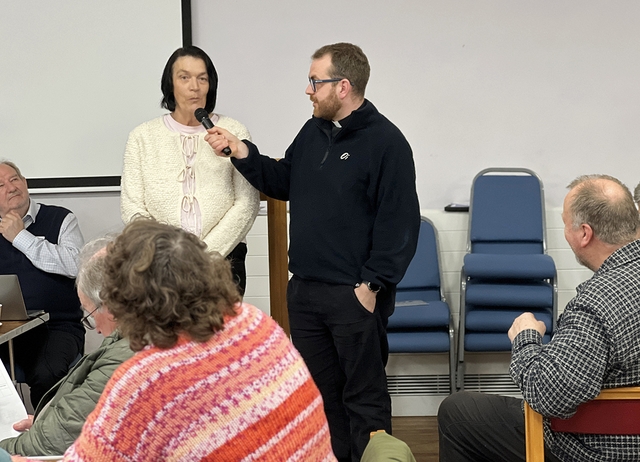
The Rev Alex-Coakley Youngs, team vicar for Harbour Church, based at All Saints, Portsmouth, introduced Angie, who was a cleaner at three churches. Her father had died and she wasn’t sure how to cope with it. She was invited to an Easter Sunday Fun Day two years ago, then was invited to come on an Alpha Course run by Harbour Church.
It helped her to embrace faith, and she is now involved with the church-planting team at All Saints Church and Spa 61, the church’s safe space that allows them to pamper women who are in need. Angie was baptised in January and has brought friends to church.
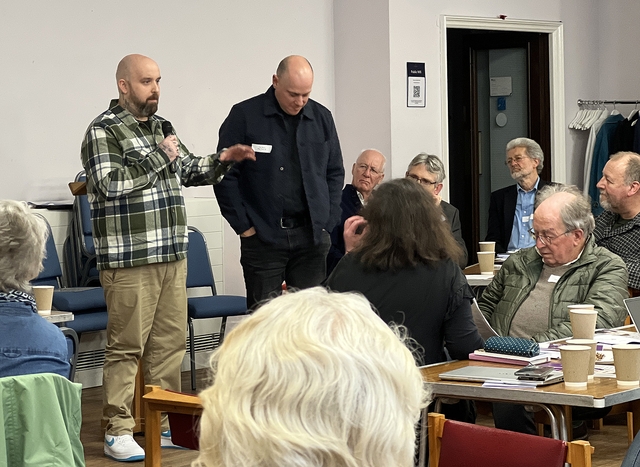
And the Rev Ray Driscoll, team rector of Haven Church in Gosport, introduced Kyle, who worked as a chef and lived opposite Christ Church. He decided to visit, experienced an amazing welcome, and joined an Alpha Course. He then began helping on Alpha Courses, felt a calling to ordained ministry and is now an ordinand studying at Trinity College, Bristol. He explained some of the barriers that he saw to ordained ministry for those without an academic upbringing.
Synod members were invited to discuss the issues in groups, alongside some of those serving in low-income communities.
The Rev Hugo Deadman then asked synod members to agree a ‘LInC commitment’, which you can see here. It commits our diocese to hearing the voices of those in low-income communities, tackling inequality and helping people to fill their full potential. Synod members approved this commitment.