-
29 January 2026
Bishop proposes amendments to education bill
Bishop Jonathan took part in a late-night House of Lords debate relating to school inspections. ... read more
-
5 December 2025
Bishop makes maiden speech in House of Lords
Bishop Jonathan has made his maiden speech in the House of Lords. He was responding ... read more
-
23 October 2025
Bishop Jonathan enters House of Lords
Our bishop, the Rt Rev Jonathan Frost, has become one of the 26 bishops who ... read more
Bishop makes maiden speech in House of Lords
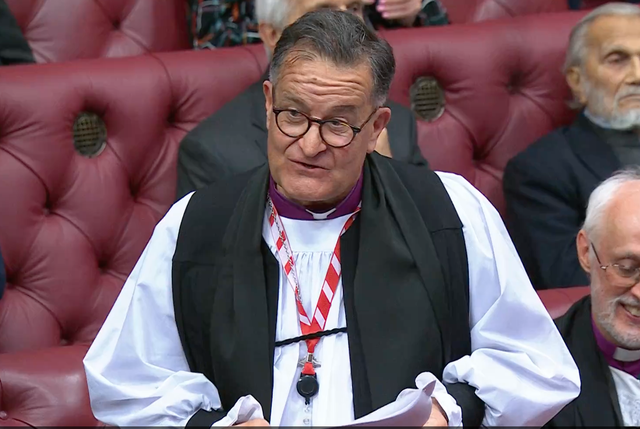
BISHOP Jonathan urged the government to tackle poverty in his maiden speech as a member of the House of Lords.
Our bishop was speaking on the debate on the government’s Budget proposals after his recent formal introduction to Parliament. He began by praising our diocese as a vibrant, confident community of communities.
He then commented on two specific aspects of the Budget – the removal of the two-child limit on universal or child tax credit, and changes to the way children with special educational needs will be supported. He urged government action to alleviate poverty, giving statistics from one deprived part of our diocese and listing some of the ways in which our churches are already helping those in need.
He said: “The Anglican Diocese of Portsmouth lives from a generous, grounded and corrigible faith, a commitment to collaboration and partnership, and a vision of the common good which includes everyone. Wonderfully, in my view, the motto for the city of Portsmouth is ‘Heaven’s Light, Our Guide’.
“Working in partnership with neighbours within the wider Christian community, and with the faith communities and voluntary and statutory sectors, the communities I lead are resolved to serve the people, neighbourhoods and communities of East Hampshire, the city of Portsmouth and the Isle of Wight, to find what is good and to strengthen it, and to work with others for the flourishing of everyone.
“In responding to the Budget Statement, there are two particular areas I want to highlight, with a couple of questions to conclude.
“I am proud to know that in my Diocese of Portsmouth, churches, faith communities, and volunteers of all faiths and none have put their shoulder to the wheel in supporting those facing poverty in these years. In the Charles Dickens ward of inner-city Portsmouth, over 50 per cent of children live in crushing poverty. In partnership, we serve food banks and provide warm spaces and outreach projects, but none of this will have the impact of the Government’s decision to end the two-child limit, which has been a leading driver of child poverty for nearly a decade, crushing aspiration, hope and opportunity. I commend the Government for this decision, but I hope and pray that this is the beginning of a renewed commitment to investment in a generation of young people.
“The second area I want to highlight, and the two questions, relate to special educational needs and disabilities. In my routine work and ministry, headteachers and trust leaders across the diocese, in a wide number of communities and across England share frequently that supporting children with SEND and disabilities has become a particularly pressing matter. I commend the families and teachers who are committed so passionately to work for the inclusion of every child.
“As my diocese bridges multiple local education authorities, I have seen at first hand the postcode lottery of SEND provision as it is played out for families in our communities. I know of looked-after children struggling to access education while waiting years for CAMHS referrals. We can do better than this: compounding the trauma and adverse childhood experience that have already disproportionately shaped their lives.
“I note the intention to bring the cost of SEND provision into the central government spending envelope from 2028-29. This will be a relief to councils holding significant deficits, but I am deeply concerned that no indication has been given to date of how the estimated additional cost involved will be covered – according to OBR, £6 billion by 2028-29 – without causing a significant fall in mainstream funding for schools. I note, too, that from 2028, the Government will not expect local authorities to fund future special educational needs costs from their general funds once the statutory override ends at the end of 2027-28.
“Once again, I note and welcome the intention to end the statutory override, which keeps SEND spending deficits off councils’ books. But I would welcome some assurance from the minister that accrued benefit deficits in local authority spending on SEND will not be paid off or reconciled by using the mainstream schools budget. Would the Minister agree with me that further cuts to per-pupil funding risk widening inequality and constraining further schools’ ability to deliver outstanding, aspirational education, perhaps especially for our most disadvantaged and vulnerable children?”
You can watch the speech in full here (the bishop’s speech is from 12:25pm onwards) and read it in Hansard here.