Diocesan Synod, November 2026
PRESIDENTIAL ADDRESS
The Ven Bob White, Archdeacon of Portsdown and vice-president of our synod, spoke in his address about the Church’s response to recent anti-migrant protests in Portsmouth and Gosport and counter-protests from others. He recalled the scene in Guildhall Square during one afternoon, with the two sets of protestors on either side of the square hurling insults at each other, with the police creating a gap between them. He suggested the Church should inhabit that space, not taking sides, but providing a different narrative that sought to respect the opinions of others, build up community and live out our role as the Body of Christ. You can read his whole speech here.
SAFEGUARDING UPDATE
Director of Safeguarding Emily Hassan was unavailable, but an update had been offered by the safeguarding team, which can be read here. Diocesan Secretary Philip Poulter indicated that a combination of sickness, holiday and a large caseload meant it was a challenging time for our safeguarding team, but agreement had been reached to prioritise casework over some aspects of training and to increase the hours of other safeguarding officers as a temporary measure.
ACT OF SYNOD
Bishop Geoff Annas, as our Commissary Bishop, read out an Act of Synod relating to Vacancy-in-See Committees Regulations 2024, as amended in 2025 and 2026. You can read it in full here.
GENERAL SYNOD ELECTIONS
Diocesan Synod members heard that three clergy and three lay people had been elected by our deanery synod members to represent us on the Church of England’s General Synod. Those six are:
Clergy:
- The Rev Jenn Camirand
- The Rev Andrew Hargreaves
- The Rev Dr Paul Chamberlain
Laity:
- Noah Chamberlain
- Ian Johnston
- Vanda Leary
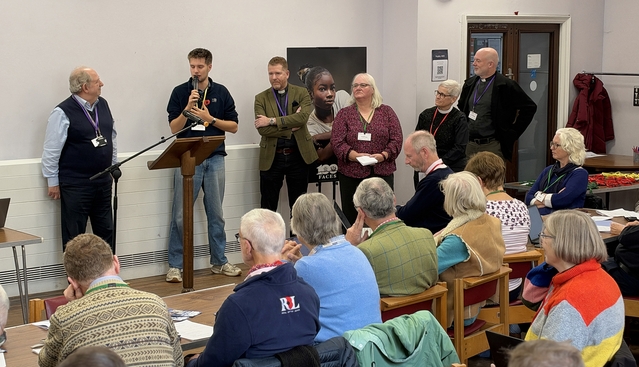
Synod members heard from five of the newly-elected representatives, who introduced themselves and explained where their priorities lay (Ian was sadly unavailable). Noah is passionate about younger voices being heard; Andrew’s passions revolve around mission and evangelism, and Vanda is keen to hold together those with different theological perspectives on LGBT+ issues, while making more progress on the Church’s acceptance of those in same-sex relationships. Jenn’s background in estate ministry means she’ll be asking what General Synod debates means for those in parishes, while Paul outlined his desire for clergy to be released to do the things they promised to do at ordination.
DIOCESAN SYNOD ELECTIONS
Synod members considered next year’s elections to the Diocesan Synod. Members agreed the allocation of seats for lay and clergy representatives across all seven of our deaneries, which you can read here. They also agreed that the method of voting should be a straightforward majority vote, rather than single-transferable vote. A sample of the voting paper is here.
There was clarification that Electoral Rolls were legally the right way to measure church membership, according to CofE rules, and therefore it was appropriate to use electoral roll figures to determine how many lay representatives should be elected from each deanery, as a proportion of the whole.
STRATEGIC FINANCE PLAN
Strategic Programme Manager Tim Pike presented a paper on our diocese’s strategic financial plan. This is a document required by the national Church of England when it considers our latest bid for funding by the Strategic Mission and Ministry Investment Board (SMMIB) in December. But it was presented to Diocesan Synod as a way of considering our long-term financial position, so that it can make budget decisions in the coming years. The paper is here and his presentation is here.
Portsmouth Diocesan Board of Finance has a deficit budget for 2026, with a budgeted deficit of £1,237k. Tim showed how our income from parish share has declined over the past 10 years, particularly if it is examined in real terms. Continued use of our reserves is not sustainable. He therefore presented three options:
- Maintain our current level of stipendiary clergy and increase income by parish share (by 2% above inflation each year). This would take seven years to achieve a balanced budget.
- Reduce stipendiary clergy numbers by 10. This would bring our budget into balance, but damage our ministry and prospects for growth.
- Achieve a change in the national funding formula to result in increased grant funding from the Church Commissioners for stipends (outside the control of our diocese, but being pursued by our bishop and others).
It was agreed that we should pursue option 1, alongside advocating for option 3. Synod members also heard there was support available as they attempt to ensure parish share contributions are paid, including a toolkit of 28 or more options. Details here.
There was discussion about whether there should be a fourth option (reduction in central diocesan costs). And there was agreement that this is a strategic plan that will be reassessed and revised over the coming years.
STRATEGIC PEOPLE PLAN
The Ven Steve Daughtery, our Head of Strategy Development, outlined a new strategic framework in the deployment of church leadership across the diocese. This is designed to help us to place the right people in the right places with the right support.
He explained that our approach to deployment would be both to ‘understand’ and to ‘stand under’ parishes, looking at the context of each parish, God’s calling to individuals and then to discern collaboratively what kind of leadership was required. This could mean that deployment was differentiated across the diocese, with some contexts requiring less investment, some requiring more capacity and some given concentrated and sustained investment. His paper is here and his presentation is here.
Steve explained that we were in the first stages of thinking about this, and promised to visit deaneries to explain more.
BUDGET 2027
Director of Finance Elaine Coe presented details of our diocese’s Budget for 2027 and a forecast for 2028-29, which can be read here. It came after a series of budget consultations in each deanery, as well as consultation with various boards and committees. Her presentation is here.
Firstly, she confirmed that we are forecast to end 2026 with a deficit of £1,206k before any transfers, which sits within our planned scenarios for the year. Parish share contributions at the end of September 2026 are three per cent higher than 12 months previously, and the sale of glebe land in Wickham has provided us with £2.2m of restricted income, the interest on which can be used in our general fund.
The 2027 budget for the Diocesan Board of Finance plans for a £1,302k deficit, based on a collection rate of 88 per cent of parish share contributions over the year. In line with the diocese’s Strategic Finance Plan, it plans for a 4% rise in overall parish share contributions (one per cent higher than inflation), as the first stage towards eradicating our deficit. But parish share requests to individual parishes will still be capped at 5%. The diocese will also be offering a toolkit to parishes, to help them increase their parish’s income and increase sustainability. We have assumed we will continue to fund 73 stipendiary clergy posts across the diocese and stipend/salary increases of 3%.
Elaine reminded us that there was still some confusion in parishes around what parish share did and didn’t pay for – for instance, it does not help to fund the bishop’s stipend, housing or office costs, or the cathedral and their clergy. More details can be found here: https://www.portsmouth.anglican.org/diocesan-finance/parish-share-explained/
Synod members approved the budget for 2027 and agreed that the Board of Finance should budget for parish share contributions of £5,762,489, targetting minimum collectiom of £5,070,990 for the year ending 31st December 2027.
NET ZERO CARBON
Diocesan Environmental Officer David Cain offered synod members the annual report on our efforts to reach net zero carbon by 2030, according to a target set by the national Church. Our diocese was – yet again - the only one to achieve 100% responses to the Energy Footprint Tool, which helps us to measure carbon emissions across the diocese. We achieved this for the third year in a row. His presentation is here.
He told synod members that more than 50% of our churches are registered as EcoChurches. He suggested that members could find out how to become Gold EcoChurches at this webinar, and discover more about the theological basis for our net zero targets at this webinar. He also commended the net zero conferences taking place in Chichester and Winchester in 2027, which are joint conferences spanning several dioceses.

CENTENARY CELEBRATIONS
Director of Communication Neil Pugmire updated synod members on plans to celebrate the centenary of both our diocese and cathedral in 2027. They include chances to thank God for the past 100 years, to celebrate our diocese in the present, and to leave a legacy for the future. His presentation is here.
Among the plans are:
- An exhibition showcasing ‘100 Faces’ – portraits and stories from 100 worshippers across our diocese which will be on display in our cathedral from April 4-24, and will also be exhibited at St Peter’s, Petersfield, and Newport Minster.
- A celebration of 100 years since the Diocese of Portsmouth was created, on May 1st 2027, with the Archbishop of Canterbury
- An outdoor service on July 18th, for which churches have been asked to cancel their main morning services to allow worshippers to attend
- A service marking 100 years since the hallowing of our cathedral on October 4th, 2027.
- ….and much more, including an exhibition of our history in the cathedral; a souvenir edition of our magazine; pilgrimages; a Choir Festival and so on.
Full details of our celebrations are on www.portsmouth.anglican.org/100