A reflection on Taizé
Written by Rev Ryan Cook, Vicar of Cowes, Northwood and Gurnard on the Isle of Wight, July 6th 2026
I had the privilege this past week of travelling with a group of young people to Taizé in France. For those who may not be aware of Taizé, I will not labour a history of the movement – the community – here. I will simply note that the community has existed for more than eighty years and was founded by Brother Roger. If you have never heard of him, it is worth your time to seek out his story, and the story of the birth and journey of the community.
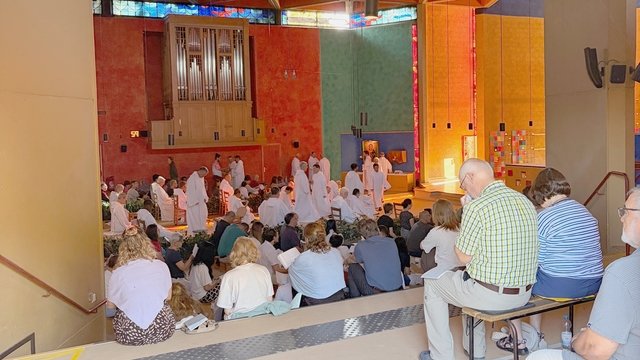
Young people have been travelling to Taizé for decades, staying for a week at a time, or longer. The community welcomes up to 100,000 young people each year. Why they continue to come – and continue to experience life change – is hard to answer. The days at Taizé are structured by prayer. Three times a day, everyone gathers in the Church of Reconciliation to pray. Between prayers there are daily Bible studies, and everyone works together, serving meals and cleaning. My upbringing taught me that if you wanted to gather young people, you would not offer them prayer three times a day with monks and chanting, and then tell them they must work each day as part of their stay. Yet the young people come. And it seems their joy increases throughout the week. There is nothing at Taizé that would look especially attractive on the marketing brochure for a youth conference.
Taizé is an ecumenical order. The Brothers who make up the community come from Catholic, Protestant and Orthodox backgrounds, representing the diversity of the church. For those who know me, ecumenism has long been part of my Christian journey, and that part of the journey has been filled with both joy and sorrow. So the ecumenical nature of Taizé has always attracted me. I had read books on Taizé, pored over Brother Roger's writings, and gleaned from this community from afar. It was a pleasure, then, to be able to go in person.
I did not have high expectations. It was only two days before the bus left that I joined the trip, filling in for a colleague who could not go. And I was not looking forward to the camping, as I am neither a willing nor a joyful camper!
The joy unfolded for me throughout the week. Particularly potent were the first few times attending prayer. No one person kicks off the prayers – there is no introduction. The prayers simply begin with singing. Many languages make up the prayers and chants, and I was not always able to sing along. This meant that at some points I stopped trying and decided simply to take it in. For a man with too many words, this was a great gift.
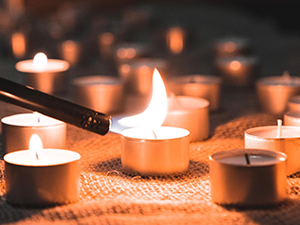
Every gathering of prayer also included ten minutes of silence. Again, if you were planning a 'youth event', you would not consider this an attractive or even possible option. But every time we gathered, there was a time of silence. A thousand young people – dead silent. That in itself speaks of a miracle. I was deeply moved by the silence all week. Silence is a way into mystery. The mystery of questions. The mystery of unknowing. The mystery of being at the end of what can be controlled with words or actions. And this silence was healing. It was prophetic. It spoke to me of the church in her diversity coming to the end of herself – to the end of her ability to machine herself into being – and embracing being one in Christ as a bedrock reality, mysteriously present and rooted in the Spirit's work, not our own.
I must confess that what I had not realised deeply enough before this week is how little attention I have given to the base reality of our being one in Christ – a reality deeper and higher than our words, systems and theories can possibly communicate. Certainly, had you asked me a few weeks ago, I might have said that the church, if she is ever to be one, will be made one by a power beyond our own. But Taizé, by its structure of silence, embedded that reality in me more deeply than I have known before. Thousands of young people from different parts of Christ's church find themselves together – beyond words – in the silence of the Church of Reconciliation. I will not get over that experience quickly, and I have begun to consider how it will change things for me going forward.
In honest moments over the years, if you had asked me, I would have told you that I carry grief about the divisions present in the church. Division is our number one scandal. It is the number one reason why, if I were not already a Christian, I would not become one. The scandal of division is the primary testimony against the truth of what we preach. And I grieve it in myself – in the places where I perpetuate it – and in others, on a very consistent basis. It is a low-level hum at the bottom of my spiritual life. But at Taizé this week, I was filled with hope.
I had the privilege of spending an hour with one of the Brothers who has been at Taizé for some fifty years. He is a Brother of the community who has also written a number of books and lives out a vocation of theological teaching within the community and the wider world. In that meeting I brought to him my grief, along with a few of my pressing theological questions about the unity of the church, and I petitioned him for answers to the intellectual questions I have wrestled with over the years.
He spoke quietly, calmly and gently over the hour we spent together. As we came to the point where I put forward some 'ideas' and questions about the way toward greater unity in the church, he paused for a moment, and then spoke to me about Brother Roger. He told a few stories of how Brother Roger, a Protestant, lived out his relationship to the Catholic Church. And as he neared the end of the stories, he quietly made the point that ecumenism – unity in the church – begins not flatly in systems or doctrine (though these things are deeply important) but in the heart and soul of the person. It begins with the internal reconciliation of the person to Christ, which overflows into reconciliation with others. It is the heart that needs changing. It is the heart that needs to be made new.
I have, of course, pondered these things in the past. Yes, we need to be made new people by the Spirit, and this is critical to loving our brothers and sisters in Christ. But, as these things go, it felt in that conversation as though the truth dropped from my head into my heart. It became clear – brighter in my mind and heart than it had been before – that councils, theological forums, treaties and agreements need to be held and made. But at the bottom of the healing of the church lies the need for the inner reconciliation of our hearts with God and with others. And, shock of shocks, this takes place on the ground: with my wife, my children, my neighbours, my PCC, and my enemies. It is the everyday work of becoming less, so that Christ may become more visibly seen.
I will not solve the theological problems of division in the macro church during my short life. Neither will you. But what you can do – what I can do – is to recognise the mysterious powers at work in the world that divide us, powers that are bigger than us. And we can enter the silence of recognising that without the work of the Holy Spirit – in our powerlessness – nothing will change. Humility is the first step. The second is internal reconciliation: seeking to be right with God, and to live more deeply, by the Spirit, the love of Christ in the realm we occupy.
Latest News
-
29 July 2025
Bishop leads two pilgrimages to Taizé
Bishop Jonathan has helped to lead two pilgrimages to the ecumenical Taizé Community in France ... read more
-
16 July 2024
Taizé trip was life-changer for young people
Bishop Jonathan led a trip to the Taizé Community in France with young people from ... read more
-
22 June 2024
Island students heading for Taizé
Students from The Bay C of E School and Christ the King College on the ... read more
Upcoming Events
-
25 October, IN: Worship
Taizé Service
Taizé-style worship offers an opportunity for peace and quiet, for stillness and reassurance. read more